

A weekly newsletter on what I’ve written, read, and otherwise enjoyed.

I was happy to appear this week on Ian Cattanach’s Write Conscious for a long conversation about my new novel Major Arcana, the current literary landscape, novelistic technique, writing and spirituality, and more, including a little gossip toward the end. I support Ian’s efforts to spark a “literary renaissance” through “transformative fiction.” As a longtime watcher of Ian’s YouTube1 channel—he might be the most original and iconoclastic of the online Cormackians—I can say he’s one of the few people around to carry the most serious of literary standards into what we might call “the spirituality space.” Thanks again for the conversation! I also noticed that the New York Public Library has promoted Major Arcana this week on their list of “Fiction and Nonfiction Reads for Comics Lovers.”2 You can order Major Arcana here in all formats—print, ebook, and audio—or in print wherever books are sold online. You might also suggest that your local library or independent bookstore acquire a copy, and leave a Goodreads, Amazon, or other rating and review. Thanks to all my readers!
Then there’s The Invisible College, my literature podcast for paid subscribers. We are more than halfway through a 15-part sequence on the modern American novel. This week, in an episode called “I Have Had to Listen Too Long,” I offer a guide to that most difficult of Great American Novels, Faulkner’s high-modernist Southern-Gothic long-sentence3 masterpiece Absalom, Absalom! Along the way I provide a theory of American Gothic and its relation to Faulkner’s Freudian agenda to “work through” the nightmare of Southern history until we are fit to arrive at a future where “I who regard you will also have sprung from the loins of African kings.” Next week: Ralph Ellison’s Invisible Man. Please remember that a paid subscription to Grand Hotel Abyss buys you access to The Invisible College’s ever-expanding archive, with over 80 two- to three-hour episodes on literary subjects from Homer to Joyce.2 Thanks to all my current and future paid subscribers!
Because it’s relevant to the Write Conscious interview, the main text this week elaborates on literature and magic; in the footnotes, some final thoughts on The Melancholy of Resistance, a capsule review of Bugonia, and more. Please enjoy!
Conscious Creation: Magic vs. Art Redux
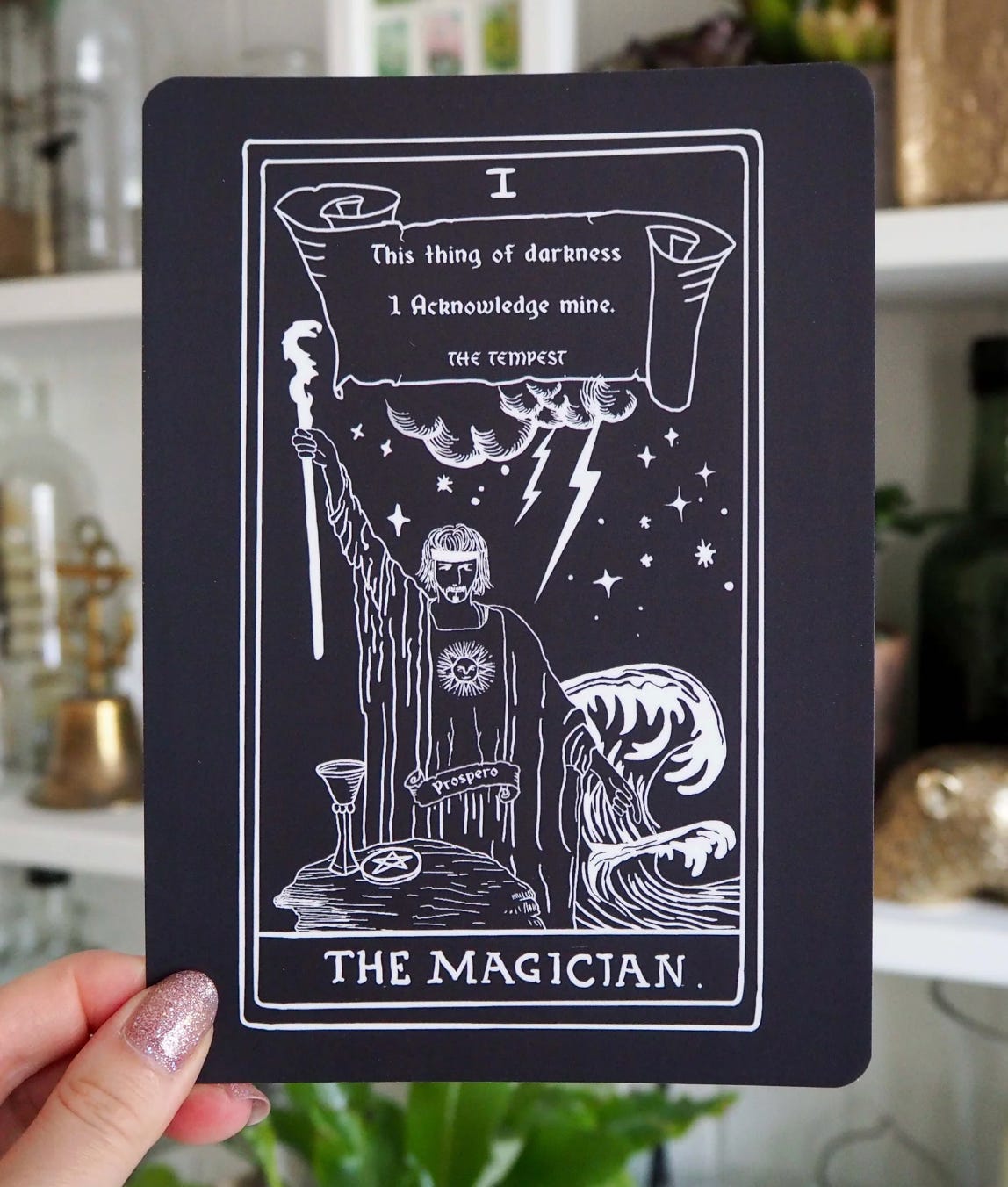
In a new post on the con- and divergences of aesthetics and occultism, Steff invites us to think about art and magic as “near enemies,” with near enmity defined as “some quality that superficially resembles a spiritual virtue but actually undermines that virtue.” While magic and art may both manifest new realities, Steff concludes, today’s popular magic produces “bad aesthetics” that artists must beware in their quest for new forms of beauty. (My [anti-]hero[ine] Ash del Greco comes to a similar conclusion in Major Arcana.)
These bad aesthetics also derive from what Steff calls the “corny” moral messages of magic’s orientation toward truth instead of beauty, such as “we’re all incarnated to learn how to love one another in disparate bodies.” With that definition, we might regard philosophy, religion, and politics—all those discourses’ many lies also claim to be the truth—as other near enemies of art, which the history of art no doubt suggests, with its many philosophical, religious, political, and magical ideologues. But, granted that Major Arcana’s conclusion has been derided as sentimental, I’m not so worried about this latter aspect of the problem. I suspect “we’re all incarnated to learn how to love one another in disparate bodies” is the final wisdom offered by many of the greatest works of modern literature, for example, like Middlemarch or The Brothers Karamazov or Ulysses, and this is probably better than a number of the available alternatives.
Because the message matters less than the vehicle in art, the message might just as well be sentimental as astringent. Everyone’s favorite tradcath literary theorist, René Girard, is perhaps right to argue for what he calls the “banality” of great literature, its deep final accordance with immemorial wisdom; he is only wrong when he fails to grasp, in his polemics against Romanticism’s and modernism’s adventures in aestheticism, that this is exactly why the form must never be banal.4 Because we have to enact truth rather than just knowing it, because we sometimes even have to invent truth, we must be startled into truth anew every day, must experience it, lest we lose it, as if it were the most counterintuitive provocation ever uttered.5 As the man said, art exists to make the “stone stony.” For this reason, bad taste may actually be immoral.6
As I told Ian Cattanach in our conversation linked above, I fear that magic can be an enemy of art not because of its will-to-truth but rather because of its will-to-system. This interferes no less than a pre-given moral with what should be artists’ free relation to their subject matter. In fact, system interferes more directly with form than truth does. The occult artist may confuse a magical system, the more esoteric the better, with an aesthetic structure. His drive to “create a system,” as Blake expressed his own motivation, harmed Blake’s work, I believe, drove him down the blind alley of those incommunicado last books, with the Pound of The Cantos and the Yeats of A Vision and even the Joyce of Finnegans Wake on his doomed trail; some of Alan Moore’s less readable recent productions are an example in our own time. Whereas other writers whose work had a magical (or at least “spiritual”) inflection nevertheless managed to convey their vision through pleasing forms organic to their sensibility and to the stories they wished to tell, rather than planned according to charts in a grimoire or imitations thereof; Virginia Woolf, D. H. Lawrence, and Toni Morrison come to mind here, and the Yeats of the poems rather than the prose, the late Yeats of “The Tower” who insists that the poet’s faith is different from the Platonist’s, that the poet must pay as much attention to necessity as to the will who transcends or transforms it, because the lineaments of necessity inspire the will to change and makes it something more than idle fancy or (as we now say in our unpoetic vaguely medical idiom) “maladaptive daydreaming”:
And I declare my faith:
I mock Plotinus’ thought
And cry in Plato’s teeth,
Death and life were not
Till man made up the whole,
Made lock, stock and barrel
Out of his bitter soul,
Aye, sun and moon and star, all,
And further add to that
That, being dead, we rise,
Dream and so create
Translunar Paradise.
I have prepared my peace
With learned Italian things
And the proud stones of Greece,
Poet’s imaginings
And memories of love,
Memories of the words of women,
All those things whereof
Man makes a superhuman
Mirror-resembling dream.
I am concerned about face-to-video’s effects on what should be the atopic-utopic effect of the literary, its beneficent and paradoxical emotionalism-through-depersonalization, hence my dramatic backlighting. (I’ve still never read Levinas, but what if he was wrong in all those books I didn’t read? What if we can only truly sympathize with someone whose face we’ve never seen?) The reliably faceless Philip Traylen, writing for Romanticon:
Only Dostoevsky and Cervantes achieve facelessness, achieve a not-mattering-what-it-looks-like. Kafka’s face could not be more present in his prose if it were incinerated and smeared (forgive me, I am trying to explode)—
Or the heroine of a novel I persist in liking better than The Melancholy of Resistance (see footnote 3 below):
She excused herself to the bathroom. There, she had to chip her fingernails untaping the square of corrugated cardboard that covered the place on the mirror where her face would appear if she stood straight before it. On the cardboard, she’d written out a quote from Pessoa: “Man shouldn’t be able to see his own face: there’s nothing more sinister. Nature gave him the gift of not being able to see it, and of not being able to stare into his own eyes.” She threw the square behind the toilet, and there she was again: Alice Nicchio-Strand at forty-six years old. She was just one year short of the age at which her mother had died, she thought, as she studied with attempted dispassion all the signs of decay, the cracks extending across the hard clay mask: the lines around the mouth and eyes that told the world how she’d been habitually straining the skin of her face, certainly not in smiles or laughter; the whites of the eyes, taking on a horrid lactose appearance to replace the clarity of youth’s vitreous bodies, like water clouding as it froze; the teeth that appeared to lengthen as they mildewed in the sour mouth; and the hair, brittle and wan and threaded with tombstone-gray. While she had known abstractly since childhood that this would happen to her, in no material detail had she predicted it, and still less had she predicted what the mirror didn’t show, the low and droning constant headache, the sting in the lower back at every wrong move, the stomach ready to spasm at every affront. She had thought of her mother as someone taken too soon; now she imagined her as someone spared just in time.
I was 30 when I wrote that. I am 43 now. Forgive me, I am trying etc. (“Trying? You certainly are,” I imagine someone objecting, to me or Philip or Miguel or Fyodor or Alice.)
I’ve unfortunately never been to the New York Public Library, but I did have Simon Magnus research Marsh Man there in the novel:
Simon Magnus’s meticulously detailed scripts tended to exhaust artists. Where other comic-book writers would begin a page with a description of the first panel that read simply, “Establishing shot on the swamp at dusk,” leaving the artist to realize the swamp and the dusk as he saw fit, Simon Magnus would request research material from the city’s vast public library—would pass between the marble lions who had since the beginning of the century maintained their guard, couchant on either side of the stairs by which you ascended to its edifice—the better to catalogue for the artist the exact number and type of plant that should be visible in the image. For one panel on a nine-panel page, Simon Magnus would produce a 3000-word description with lyric flourishes—“the water hyacinths pale like the center of a flame at dusk”—amid the amateur botany.
I swiped this from an old Alan Moore interview where he said he went to the library in Northampton to learn about the flora and fauna of Louisiana before he wrote Swamp Thing. Prior writers, he quipped, had gotten the “thing” but not the “swamp.” I knew about the lions because I used to listen to the old NYPL podcast in the 2000s; curator Paul Holdengräber, before falling into rapt conversation with Zadie Smith or whomever, would promise “to make the lions roar.” A novel is a jewel box or a Wunderkammer for all one’s most random memories and associations, which might otherwise be lost to time.
Speaking of long sentences, I’m happy to report that I didn’t “krasz out,” that I have finally finished László Krasznahorkai’s The Melancholy of Resistance. The novel did resist my effort to read it, and this did make me melancholy, but I managed to arrive at its terminus, a long description of a body’s decomposition analogized to the novel’s own concluding. The body in question is the body the novel’s prologue began with, that of the holy-fool hero’s ignorant mother, eulogized in the epilogue by the other Pythagorean-musicologist hero’s evil wife as she seizes control of the town following its whale-and-circus apocalypse. The holy fool hero, the only compelling character, goes missing for the novel’s final quarter before being locked up in Mrs. Eszter’s reign of terror, while the circus manager defends his roadshow as avant-garde art. The musicologist, meanwhile, declares a separate peace as the new order descends like an iron curtain. I’ve lost track of what it all means—CIA modernism enabled fascism to succeed communism in Eastern Europe? men are bad, but women are worse?—and I think the novel would have been a lot better had it spent more time on the quarrel over the meaning of life between Valuska and Eszter or the significance of the whale and the circus instead of devoting so many of its unreadable sentences to meaningless scenes of violence and chaos. The novel’s superficial high-modernist pastiche doesn’t go far enough; it is too much the verbal movie and not enough the pure essay it might have been. Not to sound like another famous Hungarian, but: more Mann, less Kafka. There ends my “krasz course” in our new Nobel laureate; please let me know in the comments what I’m missing.
Please see my forthcoming essay, “Romantic Truth: Imaginative Authority in the Literary Criticism of René Girard,” in the learned journal Literary Imagination for an extended argument to this effect.
I watched the Korean cult classic Save the Green Planet! years ago when I was reviewing Peter Y. Paik’s From Utopia to Apocalypse, an academic book on politics in science fiction and comics—a rare example, in fact, of an academic book on pop culture that’s openly right-wing. For Paik, Save the Green Planet! accordingly dramatizes the need for a fundamentally tragic politics, a politics alive to our irreconcilable needs and desires, as against naive progressive meliorism. (Mary Jane Eyre’s recent critique of “moral faggotry” is an argument in this spirit. Like MJE, Paik draws extensively on Simone Weil.) I can’t say Save the Green Planet! made much of an impression except for the twist ending, a twist ending Yorgos Lanthimos duly replicates in his remake Bugonia. In both films, an eco-warrior and his partner in crime kidnap a CEO he suspects of being an alien bent on destroying the earth. But Lanthimos makes the protagonist an online autodidact populist incel, one who pointedly combines MAGA and dirtbag left features into one eat-the-elites archetype, and he makes the hero’s partner a mentally disabled cousin styled pointedly to resemble old-school Kantbot. (That might sound far-fetched, but I usually assume the makers of pop culture live on the same internet as the rest of us.) The CEO, meanwhile, who was a boorish male in the Korean movie, is here a lean-in corporate girlboss played with customary comic aplomb by Lanthimos’s muse Emma Stone. In other words, Bugonia is 2025’s second Eddington: a surrealist culture-war comedy. For Eddington, as I discuss here, the culture war distracts us from the elite agenda symbolized by the triumphant data-center corporation that manipulates both the woke and the based into fighting each other instead of the “real enemy.” Bugonia accomplishes a more subtle ideological maneuver. It’s difficult to discuss without spoiling the twist, but I will try. A superficial reading of Bugonia would find the same meaning as Eddington: the populists—whether woke or based, whether MAGA or dirtbag—are correct in their anti-elite critique, but too ineffectual in their exclusion from cultural centrality to stop the elites from winning. That would be the “Reddit” reading of the film, taking note of everything but its aesthetic surface, how it feels to watch it. Bugonia, however, so feelingly insists on the sheer ugliness and disorder of the populists’ world that it gives us no choice but to align our sympathies with smart, hot, funny, charismatic Emma Stone’s girlboss and therefore with the elite—very elite, in this case—plan she serves. (This in contrast to Eddington, where the desert landscape offers an alternative to the control grid even if no character does, not even the one played by Emma Stone. Bugonia’s comparable pastoral of backyard bee colony is wholly engulfed by the incel lair it bathetically adorns.) In other words, Bugonia feints toward the new populism, especially in its opening Helen Andrewsish satire of corporate feminization, but hits us hard in the end with the “elite human capital” worldview, or “elite capital” anyway, somewhat in the manner of Poor Things’s walled-garden girl-power conclusion. The title is a Greek word referring to the myth that bees spontaneously generate from animal carcasses. This applies both to the film’s bee motif and to its speculations about the origin of humanity on earth. Both titles are bad, but Save the Green Planet! might sound better in Korean. Qua movie, Bugonia is entertaining enough—Emma Stone really is hilarious—but I’ve had enough of the auteurs and their alienation effects and political testaments for one year. (“You’re one to talk,” Major Arcana readers will object. Yes, but I only had to write it. I didn’t have to watch it!)
For this week’s most stirring attack on bad taste, please see Ella Dorn’s “Make Book Covers Sexy Again” on contemporary book design and the broader aesthetic of “bookishness,” which cuts the literary off from the rest of the arts and makes it appear to be solely an affair of the smarter-than-thou introvert sapiosexual subculture, which the general population wisely ignores, probably because the general population is fragmented into its own equally tedious niche subcultures. Ella points to Penguin’s Iris Murdoch covers from the 1970s as an example of the revived eros we require. Please see also—though the rubric here is more “cool” than strictly “sexy”—my own celebration of 1990s Vintage International cover designs as against cartoonishness, cutesiness, and whimsy in book art.
Was prepared to start an entire beef over your Kraz verdict after this week's Faulkner slander, but, truthfully you didn't miss much. Krasznahorkai fundamentally *is* a writer of the cinematic mode more similar to Cormac and Flannery (though lacking their more romantic qualities) than any of the high modernists, or even a contemporary modernist who invents new devices of their own (does one even exist?) I just think he lives in this mode well. He switches to the more essayistic mode well during the inaugurating Mr. Eszter chapter but the way he balances this internal key theorizing with the sensory terror of the town during his walk with Valuska was brilliant, and something Mr. Tarr was unable to replicate with the camera alone during that scene in Werckmeister Harmonies. The same goes for the scene where Valuska is reading the diaries of the rioters where they are stalking their victim (for the crime of leaving their mob), and the whole thing goes on and on as they draw ever nearer to their prey, continually hoping the man will escape despite the situation getting more and more hopeless. You positively cannot write a scene like that with paragraph breaks, to do so would have heavily sacrificed its claustrophobic tension. Sometimes these modernist tricks aren't just alienating techniques meant towards grand gesture, sometimes they simply contribute to the entertainment (and none of us are so highbrow as to want to get rid the novel of all entertainment, are we?) Now does this paragraph blockade work for every scene he writes in the entirety of his career? Not really; these kinds of text walls would have more purpose, and would therefore be more impressive, if they *were* broken a bit more. But moments like the diary scene are where Krasz shines.
I don't think Mrs. Eszter and her reign of terror are meant to really symbolize the CIA. All of her sections are too farcical, too bumbling (okay, maybe she does symbolize the American CIA). Her seizure of power feels mostly like a product of luck as much as opportunism as the circus kind of does most of her job for her. She is more like any number of revolutionaries usurping the last revolutionary to be usurped herself than something so supreme omnipresent as the American deep state (which too will decay and fall by the novel's logic). If we're searching for meaning in this novel, we might consider that Valuska, his mother, Mrs. Eszter, and Mr. Eszter all are obsessed with different kinds of harmony respectively: celestial, infrastructural, societal, and musical. All fall against a metaphysic of decay but decay is the great liberator of all reigns of terror. (Did we need a whole faux-modernist novel just to res-state Matthew 5:45? Probably not, but I'm sure I'm missing plenty from this book as well).
Mr. Eszter's obsession with this harmony is something almost relatable (in the contemporary Anglo world, Mr. Eszter would be a play-at-home guitarist obsessing over the circuitry of a Klon Centaur, seeking out precise germanium diodes to recreate the exact tone of the original while still making it "true bypass" like modern pedals, measuring the waves of the clipping with his Dumble Overdrive special and finding some way to obsessively measure it against to the master of some Stevie Ray Vaughn track, all in an attempt to distract himself from the fact that he no longer has the freedom to tour or even play out on weeknights nor the Dionysian impulse necessary to make compelling original music in the first place). I also wish more time would have been spent on the tension between his worldview and Valuska's as well as the circus. He could have written fifty more pages of that, fifty less pages of Mrs. Eszter's political machinations and I'd have given this book 5 stars. I'm going to be really annoying now and say if Krasznahorkai is supposed to be any kind of literary genius deserving of the Nobel, that argument would have to be made from Satantango, not Melancholy. Satantango is where he actually is formally innovative and doesn't just backspace the paragraph breaks to appear so. He's even less essayistic/more cinematic there than he is in Melancholy, but unlike in Melancholy, the form *is* the meaning: in the way he plays with time, the way his non-linear chapters embody a sort of dance (if you will, a tango). That's really where his difficulty lies, not in actually reading the book but in using its formal clues to put together its meaning. I understood that novel even less, and suspect a second reading of it will either elevate it to at least a top 10 postwar modernist novel or else make put aside Krasznahorkai entirely.
Thanks for pointing me towards Paik. I'm indeed sympatico with the viewpoint he expressed in this article "Extinction and Judgment: Misanthropy in the Anthropocene"
https://www.kci.go.kr/kciportal/ci/sereArticleSearch/ciSereArtiView.kci?sereArticleSearchBean.artiId=ART002485410
"For only in a society in which the dead have been stripped of any meaningful role in shaping and guiding the lives of the living could the sentiment that the human species is not worthy of continued existence become openly expressed."